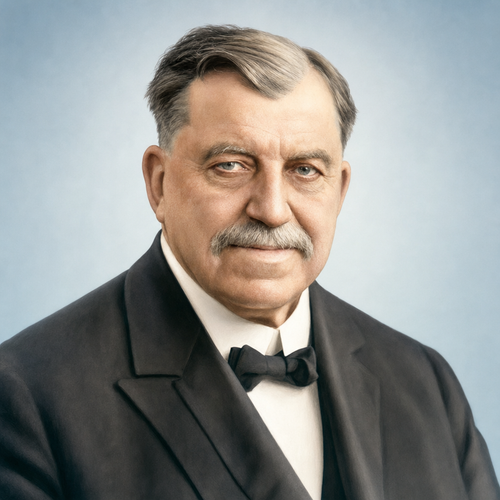
Russell Herman Conwell (1843–1925) was one of the most compelling figures in American public life — a Baptist minister, celebrated orator, philanthropist, and the founder of Temple University. Born in South Worthington, Massachusetts, Conwell served in the Civil War as a Union Army officer, an experience that profoundly shaped his character and catalyzed his Christian faith. After the war he pursued careers in law and journalism before answering a call to ministry, becoming pastor of Grace Baptist Church in Philadelphia in 1882. His magnetic presence and practical, uplifting sermons drew enormous congregations and established him as one of the most sought-after speakers of his era.
Conwell is best remembered for "Acres of Diamonds," a lecture he first developed after traveling through the Middle East in 1869 and went on to deliver an extraordinary 6,152 times across the United States and the world. The speech's central message was both simple and radical: the resources for wealth, achievement, and fulfillment are not hidden in distant lands or reserved for the privileged few — they lie in one's own community, waiting to be recognized and cultivated. This message resonated deeply with working Americans during the Gilded Age, offering a democratized vision of success rooted in diligence, creativity, and awareness of one's surroundings. The revenue Conwell generated from these lectures funded his most enduring legacy: Temple University, which he founded in 1887 to provide affordable higher education to working-class students who could not access traditional colleges.
More than a century after his death, Conwell's ideas continue to inspire personal development audiences worldwide. Nightingale-Conant has long recognized "Acres of Diamonds" as a foundational text in the success literature canon — a speech so powerful, so direct, and so timelessly motivational that it shaped the genre itself. Conwell's conviction that opportunity exists wherever we stand, if only we have the eyes to see it, remains as urgent and energizing today as when he first delivered it to packed audiences in towns and cities across America.